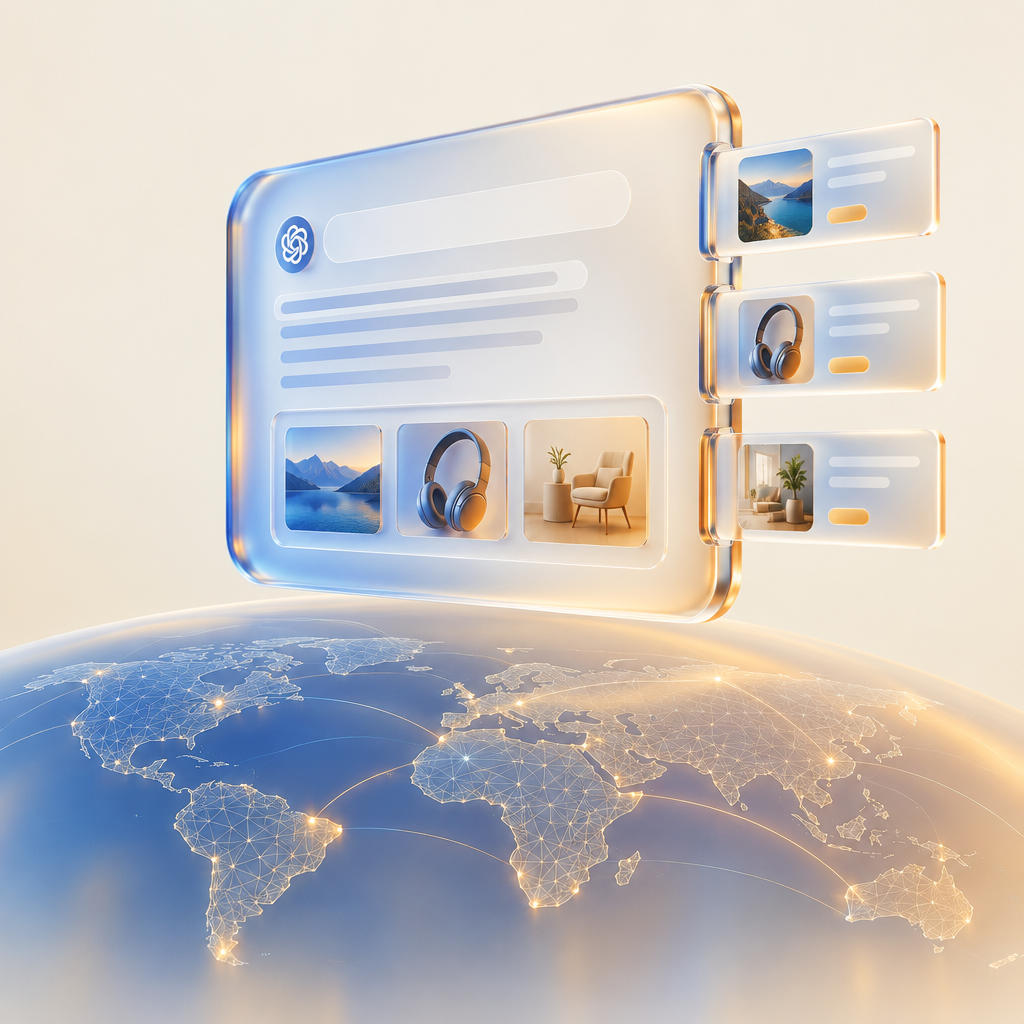
On October 5, 2026, OpenAI announced three changes to ChatGPT Ads that collectively signal a shift from experimental to operational: a new visual ad format, expanded measurement integrations with ten attribution partners, and brand suitability pilots. ChatGPT now reaches 1.2 billion people each week, making it what OpenAI describes as the world's largest AI-native consumer platform.
For B2B marketers, this matters because the surface where buyers increasingly ask questions about software, services, and vendors is now also a surface where competitors can pay to appear. Understanding how the ad layer works alongside organic AI visibility is becoming a core competency.
What Is New in ChatGPT Ads
OpenAI introduced three components in its October 5 announcement.
Visual Ad Format
The new visual ad format shows products and services through imagery rather than text alone. Ads display product inspiration, product usage, or the experiences a product enables. Testing begins in late October 2026 in the United States with an initial group of advertisers. The ads will appear during image generation in ChatGPT.
OpenAI stated that ads will be clearly labeled and kept separate from the images ChatGPT generates. The company also said advertising does not influence the answers ChatGPT provides in conversation.
Expanded Measurement
The measurement expansion is the most operationally significant change for B2B marketers. OpenAI now supports:
- Conversion data integrations with Hightouch, Tealium, and LiveRamp, making it easier for advertisers to send conversion data from existing systems to ChatGPT Ads
- Ten attribution partners across web and app: AppsFlyer, Triple Whale, Adjust, DV Rockerbox, Northbeam, Branch, Singular, Kochava, Airbridge, and Tenjin
- Conversions API support, reporting, and click attribution through these partners

This means B2B teams can now measure ChatGPT Ads using the same attribution infrastructure they already use for Google Ads, Meta Ads, and LinkedIn Ads. For teams running multi-channel campaigns, this closes a significant measurement gap.
Brand Suitability Tools
OpenAI is developing new brand suitability tools to give advertisers more control over where their ads appear. The company announced pilots to help brands understand how placement safeguards work. Details are limited, but the direction signals that OpenAI is building toward the kind of brand safety controls that enterprise advertisers require before shifting budget.
The Scale: 1.2 Billion Weekly Users
ChatGPT's 1.2 billion weekly users put it in a different category from other AI platforms. For context, Google processes approximately 8.5 billion searches per day, but ChatGPT's conversational format means users spend more time per session and ask more complex, multi-part questions.
For B2B marketers, this matters because ChatGPT is increasingly where buyers start their research. A Gartner study cited by Forkast on October 7, 2026 found that 51% of B2B buyers now start their purchasing research with an AI chatbot. When a buyer asks ChatGPT to compare CRM platforms or recommend an AR automation tool, two things happen: the organic answer cites certain sources, and the ad layer shows certain brands. Both shape perception.

Geographic Expansion and Custom Audiences
ChatGPT Ads has been expanding steadily since launch. The platform rolled out beyond the US in March 2026 to Canada, Australia, and New Zealand. It launched in the UK in June 2026. OpenAI also recently expanded to 31 European countries.
In addition, ChatGPT Ads now supports custom audiences. Advertisers can upload customer lists for audience matching. At an illustrative 50% match rate, a minimum usable audience would need approximately 50,000 raw identifiers, with 200,000 recommended for effective targeting.
How ChatGPT Ads Fit Alongside GEO
This is where B2B marketers need to think carefully. ChatGPT Ads and Generative Engine Optimization (GEO) are not competing strategies. They are complementary layers of AI visibility.
| Layer | What It Does | How It Works | Measurement |
|---|---|---|---|
| Organic AI citations (GEO) | Brand appears in ChatGPT's conversational answers | Earned through authoritative content, third-party mentions, structured data | AI visibility tools (OtterlyAI, Profound, Seen) |
| Paid ChatGPT Ads | Brand appears in ad placements within ChatGPT | Bought through OpenAI's ad platform | Conversions API, ten attribution partners |
| Combined strategy | Brand appears in both answers and ads | Integrate earned + paid AI visibility | Unified attribution across organic + paid |
The brands that will win in AI search are the ones that treat organic citations and paid placements as one integrated visibility strategy. A buyer who sees your brand recommended in a ChatGPT answer and then sees your visual ad in the same session receives a compound signal that is stronger than either channel alone.
What B2B Marketers Should Do Now
-
Audit your organic AI visibility first. Before spending on ChatGPT Ads, understand where your brand currently appears in ChatGPT answers for your category's key questions. If you are invisible organically, paid ads alone will not build the authority that compounds.
-
Start small with visual ad testing. The visual ad format is in testing with a limited group of US advertisers. If you can get access, test with a narrow set of high-intent product queries rather than broad brand awareness campaigns.
-
Connect your existing attribution stack. If you already use AppsFlyer, Kochava, Branch, or any of the ten supported partners, integrate them with ChatGPT Ads before launching campaigns. This gives you cost-per-acquisition data comparable to your other channels.
-
Prepare brand suitability requirements. OpenAI's suitability tools are still in pilot. If your organization has specific placement requirements, document them now so you can evaluate ChatGPT Ads against your standards when the tools mature.
-
Layer paid on top of GEO, not instead of it. The Sourcelift AI Shelf Index (October 7, 2026) found that 72% of AI answers cite no brand website. Paid ads can fill that gap temporarily, but organic authority is what sustains visibility when ad budgets pause.
Read Next
- Getfluence and OtterlyAI: Closing the Gap Between AI Visibility Measurement and Editorial Action
- The Third-Party Agent Problem: Why Security Built for AI You Chose Misses the Agents You Did Not
- Siri AI at Day 28: Apple Ships Hardware but the Enterprise Half Does Not Exist
- Shadow AI Agents: The Unregistered Threat Already Inside Your Workflows